Wednesday, 26 February 2020

Essential Caravan Equipment

So, what do you need to start caravanning? Our guide should help.

Towing License?

First things first, you’ll need to check when you passed your driving test. If it was before 1 January 1997 you’ll be able to tow. If it was after that date, you’ll only be able to drive a vehicle up to 3500kg and a trailer (caravan) up to 750kg behind it. So, if you want to tow a heavier caravan you’ll need to pass an additional test. For more information, head over to the Camping & Caravanning Club information page.

Towbar

Choose the right towbar for your car. To do this, check manufacturer’s websites (Witter, Westfaila, AL-KO) to find one suitable for you.

Security

There are various devices on the market which can help to protect your caravan.
  • Hitch lock
  • Wheel clamp
  • Alarm
  • Tracker
  • CRiS
Check out this useful guide to Caravan Security Devices for more information.

Insurance

Your car insurance will usually provide third party cover for towing your caravan, so would cover any damage to other cars if you had an accident. However, you would have to pay for any damage to your caravan, so make sure it’s protected against accidents, breakdown and theft with adequate insurance.

Awning

Extend your living space with a caravan awning. Our guide to caravan awnings may help you choose.

Motor mover

Caravan motor movers allow you to easily manoeuvre your caravan into position whether that be into a driveway, storage or touring pitch, or even hitching up. This guide gives more information.

Water Carrier

You’ll need to have a container suitable for collecting water to bring back to your caravan. An Aquaroll is a great option which can be rolled along the ground.

Water Pump

Connect your Aquaroll to your caravan taps with a waterpump. Popular brands are Whale and Truma.

Waste Water Container

Waste water, or ‘grey’ water needs to be collected by a waste water container, which plugs into your caravan waste drain points. Wastemaster is a popular brand.

Leisure Battery

Whilst most campsites will provide EHU (electric hook up), it’s still useful to invest in a leisure battery so you can power your fridge, heater and lights. There are several types of leisure battery, and all have their pros and cons, so make sure you do your research before you purchase. This guide to leisure batteries is very useful.

Gas Bottle

Power your fridge, heating, gas cooker and shower with gas. Bottles are typically butane or propane and come in 6kg or 7kg bottles. Butane gas is ideal for the summer months, but for winter, propane is better as it’s unlikely to freeze in cold weather.

Mains Lead

To connect to an EHU, you’ll need a mains lead which costs around £50. Make sure it has an IP44 rating which indicates the level of protection given to sockets from water penetration.

Caravan Step

Don’t forget to pack some portable steps to make getting in and out of your caravan a whole lot easier.

Corner Steady Jack

When you pitch up you’ll need to lower your corner steadies. Wind them down with a corner steady jack.

Toilet Chemicals

Reduce unpleasant smells, break down all the nasty stuff, and keep your toilet working effectively with toilet chemicals. Pink chemicals are added to the fresh water tank to keep the flush clean and provide a nice aroma. Blue or green chemicals are put into the waste tank and break down waste matter.

Towing Mirrors

If you’re towing a vehicle wider than your car, you’ll need towing mirrors. You can buy stick on towing mirrors, strap on towing mirrors or bracket style towing mirrors. Prices range from around £15 to about £150.

Friday, 31 January 2020

Useful Caravan Equipment

Fire Safety Stick
Fire Safety
Stick

Fire Safety Stick

The Fire Safety Stick is a small, portable fire extinguisher, which is lightweight and perfect for caravans and motorhomes. Unlike most fire extinguishers, it doesn’t contain gas, isn’t pressurised and won’t make a mess. Plus, it’ll work on all major types of fire and is safe and easy to use.

Lock’n’Level

Lock 'n' Level
Lock 'n' Level
This is a system of air bags that levels your caravan. You’ll still be able to fit both AL-KO Secure wheel locks on a twin-axle caravan. No more transporting ramps for levelling, these wipe clean units make levelling your caravan a breeze.

Price from £119.95

Multi-tool

Why take your entire tool-box when you can take just one handy gadget which combines all the essentials. A multi-tool will combine implements like pliers, wire cutters, scissors, screwdrivers and various blades and can range in price from around £10.00 up to £200.00.

A good starting point would be the Leatherman Squirt PS4 at £45.99. Buy on Amazon

Mini Vacuum cleaner

The easiest and quickest way to keep your tourer spick and span is with a portable vacuum cleaner. A rechargeable mini hoover can be on charge when you’re hooked up, and won’t take up much space.

Wifi Booster Kit


Collapsible Accessories
colpas collaps
Colpaz Collaps

Save vital space with collapsible version of all your caravanning kitchenware. From small bowls and mugs to kettles, washing bowls and 12-litre water carriers, the Outwell Collaps collection is a great addition to anyone’s kit.

Jetboil Fuel Guage
Jetboil Fuel Guage

Fuel Guage 

Calculate how much fuel you’ve got left in the canister with the Jetboil JetGaufe Digital Fuel Canister Scales.

From around £15.

Wednesday, 29 January 2020

Eco-friendly Caravanning


It’s safe to say that we should all be attempting to become more eco-friendly and live more sustainably. This shouldn’t just apply to when you’re at home or work. We’ve got some advice to help you make your caravan or motorhome holidays better for the environment.

It would make sense to say that caravanning holidays reduce the need for air travel and if you’re staying in England, the ferry too, therefore saving tonnes of carbon dioxide emissions and other pollution every year.

Buying a Caravan

If you’re new to caravanning, why not consider buying second hand. Save a pre-used caravan from the scrapheap; it’ll still have plenty of life left in it, and it’ll cost you significantly less than buying new.

If you’re buying new, choosing a lightweight model will mean you’ll use less fuel to tow it, whilst effective insulation will help to reduce the need for air-con in summer and heating in winter.

Try Solar Power

Solar panels can be easily fitted to your caravan roof. Using sunlight, they can then charge your caravan’s batteries when no mains hook up is available.
There are many solar powered products which you could switch to: lights, speakers, toothbrushes, cookers, and even showers!
Rather than using electric chargers for your mobile devices, try solar powered alternatives. You can pick these up online from as little as £30.00 from retailers like Amazon and Mobile Solar Chargers.

Plastic, Plastic, Plastic!

Just as you would at home, try and avoid single use plastic.
  • Invest in a metal flask for your drinking water
  • Store foods in stainless steel containers – they’ll be lighter than glass jars.
  • Use reusable wax paper to wrap leftovers or picnics in, rather than cling film or foil.
  • Use eco-friendly tableware. OLPRO Husk plates, cups and storage sets are made from rice husk which is an agricultural waste. This tableware is biodegradable and doesn’t contain any harmful substances. Other alternatives to plastic would be bamboo or recyclable stainless steel.
  • Colapz make collapsible products like water dispensers, portable showers, tableware and storage containers made from eco-friendly materials, and produce a smaller carbon footprint because they take up less space when being distributed.
  • Avoid buying food wrapped in plastic by shopping at local markets and farm shops. 
  • Bring frozen meat from home – it’ll keep other food items cold, and you can eat it once it’s thawed.

Cleaning

Rather than using harsh chemicals to clean your caravan or motorhome, try a non-toxic alternative. Companies like Sleek Clean Care provide a range of eco-friendly cleaning products which provide powerful cleaning whilst being biodegradable and not tested on animals. Even the container it comes in is recycled. 
Remove the need for toilet chemicals and install a SOG Toilet. A low powered extraction fan draws air to seal off odours and filters them via a charcoal filter to the outside of the caravan. The naturally treated waste has far less smell when emptying the cassette. 

Eco-Friendly Caravan Sites

The David Bellamy Conservation Awards program recognises caravan sites which do their best to minimise their impact on the environment. These sites encourage wildlife, reduce their energy and water consumption, reduce and recycle the waste they produce and support their local communities. Find an eco-friendly caravan site here.

x

Wednesday, 27 November 2019

Caravan Awnings


Kampa Leggera AIR 260 Caravan Awning 2020

Kampa Leggera AIR 260 Caravan Awning 2020

Whilst an awning isn’t an essential piece of caravan kit, they can extend your living space dramatically, giving you more space to relax and eat, even dry wet clothes, particularly during wet weather.

Think about what you will be using the space for; will it just be a storage space, or so you want to be able to dine or even sleep in there?

Will you want to remove side panels so that you can use your awning as a sun shade, does it need to be lightweight if you are restricted in terms of weight you can carry, and will it be exposed to the elements a lot and need to be highly water resistant?

Porch Awning or Full Awning

Firstly, you’ll have the choice between a porch and a full awning. Whilst generally smaller than full awnings, porch styles are easier to erect and less bulky.
For longer holidays a full awning may be a better option, giving you maximum living space. They’re heavier and can be trickier to erect, but you won’t be handling them as often. 
Bailey Discovery Air Awning

Caravan Awning Fabrics

Lightweight polyester dries quickly and makes for an easily constructed awning, making it perfect for short breaks away. Heavier polyester is more robust, so is likely to last longer than its lightweight counterpart.
Acrylic fabrics are more rigid, and more resistant to UV light because of the manufacturing process it undergoes. Acrylic coated polyester provides UV, mildew and water resistance.

Caravan Awning Frames

Steel awning frames can be good for longer stays & sturdy enough for a variety of weather conditions, but heavy if you have to frequently build & transport.
Aluminium & Glass-Fibre are lightweight & easy to handle, but can be compromised in bad weather.
Air (Inflatable awnings) are easy to erect & quick, especially if you have an electric pump.

What Size Awning Do I Need?

Awning sizes are called A-measurements and the size of awning you need will depend on the length of your caravan. The A-measurement is the distance around your caravan’s awning channel plus the distance from the end of the channel to the ground.
Head to your caravan manufacturer to find out your awning size – most will have a resource on their website to help you.

How Much Should I Pay?

Porch awnings start at around £150.00, whilst you can expect to pay upwards of £600 for a full awning. If you’re likely to be using your caravan awning frequently, for extended periods of time, it would make sense spend a decent amount – it’s worth investing in a good quality product which is designed to last. If you tour less frequently, or just for a few days at a time, a budget option may be a better choice. 

Caravan awnings are covered by quality standard BS ENISO 8936 – Awnings for Leisure Accommodation Vehicles. Before making a purchase, it’s a good idea to check that your chosen awning carries this award.

Caravan Awning Tips

  • Never pack an awning away when it is wet, or even slightly damp, as this is highly likely to result in mildew forming.
  • Avoid storing your caravan awning in your caravan over winder, as the conditions will be too damp.
  • Re-proof your awning yearly.  


Wednesday, 16 October 2019

Caravan Security Devices & Your Insurance


Whether you’re sticking close to home or travelling on the road trip of a lifetime, fitting the proper security devices to your campervan is the best way to ensure your safety. But not only do security devices play a crucial role in maintaining your safety, but they can also have a direct impact on your caravan or campervan insurance. Many insurers advise that security options should be added to your touring vehicle, but what do these additions do in terms of your insurance? In some cases, it can have a positive impact on the price you pay.

Read on to discover more about security devices and the ways they can impact the price you pay for your leisure vehicle insurance when it comes time for renewal.

Locking devices and clamps
The most basic and classic of security devices, security locks are a common measure that many caravan and campervan owners use to avoid their vehicle being broken into or stolen when left alone. Either when travelling or on the front drive, these locking systems are just as effective either way to ensure your contents are left secure, and your tourer is kept safe. There are many different forms of locks and clamps available on the market, including:
Caravan Wheel Lock

Steering wheel locks
This classic method applies to campervans and motorhomes in the same way it applies to other on-road vehicles such as cars and vans. Typically, a steering wheel lock is placed over the wheel of the vehicle, preventing the theft of the vehicle without the ability to unlock. Some campervans now come with this feature built-in, though it depends on the exact model.

Ground anchors
A form of lock traditionally used for both caravans and campervans, these anchors all for the secure fixing of the vehicle to the floor. This method is particularly useful for times when your tourer is left at home, whether you’re at work or going on a trip abroad without it. It ensures the vehicle cannot be driven away using specialised clamps that are incredibly strong and hard-wearing.

Security posts
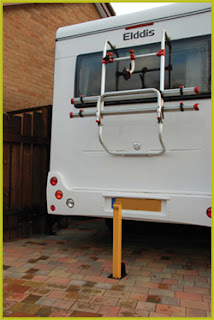
A measure often used in commercial and retail car parks, security posts can be an excellent way to prevent a caravan or campervan from being stolen; by literally blocking the exit route. In the majority of cases, a removable post can be locked upright in front of a vehicle to prevent the caravan or campervan from getting past if stolen. These posts may be more costly as their required cementing to be useful, but they can be a highly valuable tool to prevent theft.

caravan security post
Caravan Security Post
So, what is the benefit of installing locking security measures? Beyond the obvious, the reduced risk or chance of theft, using these additional security tools can reduce the price of insurance. Some insurance companies will provide a discount for leisure vehicles that are kept in a safer location, thanks to that same reduced risk.

Immobilisers and alarms
As with any other on-road vehicle, from trucks to cars, the use of inbuilt alarms in caravans and motorhomes is a necessary feature that comes as standard with many of the more modern models available on the market. But it’s possible to do even more to prevent break-ins and theft by announcing the presence of an alarm system, via a visible device or using well-placed stickers. These can be as much of a deterrent as the alarm itself. These are the options typically available to leisure vehicle owners:

Alarms
Many tourers come with alarms as standard. As with a house alarm, these are designed to trigger if an intruder accesses the vehicle. In some cases, these alarms can be linked directly into a security company for added safety. In others and more standard models, these alarms make a great deal of noise to draw attention to potential theft.

Immobiliser
Again, like any other form of on-road vehicle, caravans and campervans often include an immobiliser device. This security tool prevents thefts should the worst happen by not allowing the vehicle to be driven unless it is unlocked first. Some modern vehicles include this as standard, while older models may require a physical immobiliser that is directly fixed to the wheels. It’s worth confirming if your caravan or motorhome includes the less physically demanding method when you purchase it, as it is a valuable feature to have.

As with the security locks and clamps mentioned above, the inclusion of a high-quality alarm and immobiliser – either included with your vehicle or added as extras – can bring down the overall cost of insurance. As these features are significant deterrents to theft, they make your vehicle less high-risk, and therefore your insurance quotes cheaper.

Other security options
In addition to alarms, immobilisers and locks, modern caravans and campervans can come with, or be equipped with, a whole host of different security devices to further reduce the cost of your insurance. Here are just a few of the additional security options that could be installed for safety, security and insurance reduction:

Tracking devices
Tracking devices are an increasingly common option for both caravans and campervans, with some insurers now offering a discount on insurance when recommended tracking devices are installed within the vehicle. These devices are not visible, discrete and easy to use, often allowing tracking either through a security company or smartphone. Should your vehicle be stolen, it vastly improves the chances of recovery – which is why it can be a great way to get a discount on your campervan insurance.

Dashcams
A less common but increasingly popular addition to motorhomes and campervans, dashcams are a vital evidence tool for insurance companies. As such, it makes sense that installing both front-facing and rear dashcams within a campervan can sometimes reduce your insurance costs, especially when it comes to being on the road for days or weeks at a time.

Choosing the best insurance for you
Picking the best campervan or caravan insurance for you means ensuring that it does everything you want it to do. But equally, you want to pick an insurance that puts your safety, and that of your vehicle, first. 


Friday, 4 October 2019

Are Caravan Covers a Good Idea?


As the touring season draws to a close, you may want to start thinking about storing your caravan for the winter.

Is a caravan cover necessary? 
Do the pros outweigh the cons?

A caravan cover will protect your tourer from rain, dirt, tree sap and UV fading, and even scrapes to the bodywork. However, some would say that they also cause damp and are a hassle to fit.

A caravan cover will need to be breathable in order to allow moisture and condensation to escape from the inside, and water-proof to protect your caravan from the elements. Covers which are only water resistant may let water through in heavy rain.

How to Choose the Correct Cover

If you do decide to get a caravan cover, size is everything. Measure the length of your caravan body (parallel to the ground) from front to back, including the gas locker but not the A-frame.

Ready-made covers, or universal covers, as they are sometimes called, come in a range of sizes, and will secured by way of a strap underneath and an elasticated skirt. If your caravan is between sizes, go for the smaller option, as the excess material in the larger size will prove difficult to secure and may tear in windy weather.

Semi-tailored covers are designed for specific makes of caravan so should take into account variations in profile design. However, they’re unlikely to align perfectly with doorways allow for roof lights.

An alternative option is to go for a made-to-measure cover. A tailor made caravan cover will fit your caravan exactly and allow for aerials, doorways and flues. Companies such as Pro-tec Covers and Specialised Covers offer this service.

How much do caravan covers cost?

Ready-made covers range from as little as £70 to around £100, whilst bespoke caravan covers start at around £300. Whilst they are considerably more expensive, tailor made covers are generally easier to fit, can be customised, and will be made from higher quality material allowing a greater degree of breathability, water resistance and durability.

Caravan Cover Care
  • Always clean your caravan before fitting a cover, as this may cause scratching. 
  • Caravan covers can be washed using warm water and soft sponges. Detergents could impair the breathability of the fabric.
  • If your caravan is going to be in storage for a long period of time (over the winter) remember to check both your caravan and your cover regularly.

  
The Bottom Line

We think caravan covers are well worth considering, and you should spend as much as you can afford. If you’ve bought a brand new caravan, it makes sense to pay a reasonable amount on a cover to make sure your tourer stays in pristine condition.

Wednesday, 11 September 2019

How to Avoid Buying a Stolen Caravan

caravans-for-sale
Guest Post from Caravans for Sale
When it comes to purchasing a new car, caravan, motorhome or any high value product it’s always best to do as much research as possible. Although the majority of the time there will be nothing untoward about the vehicle you’re viewing, there is always a risk, so it’s important to be aware. Buying a brand new caravan is great and comes with loads of benefits if you can afford to do so, however most people tend to buy second-hand which is where you need to be extra vigilant. 

There is no one sure fire way of knowing if you are buying a stolen caravan as thieves are becoming more and more wise to the tricks they need to use to get away with it. However,  there are some steps you can take to reduce the risk. Of course the majority of dealers and private sellers are completely trustworthy, but a few dodgy sellers mean you need to be aware of a few things. When looking for a new or used caravan for sale, it is best to either purchase directly from a dealer or look on a reputable marketplace website that moderates ads, for peace of mind.

Here are a few tips to avoid buying a stolen caravan:


Be wary of cash payments!

If the seller refuses to give you the caravan unless you pay cash this should ring alarm bells. Most transactions are typically done by bank transfer or card payment nowadays so a cash only sale is very rare. If the seller is insisting on a cash payment, it’s likely there is something dodgy going on and you should avoid the sale and look elsewhere. It’s much better to be safe than sorry. 

Too good a deal to miss?

If the price seems too good to be true - question it! Stolen caravans are not the easiest to hide so thieves would want to make a quick sale and therefore not price at the same level a reputable seller would. It’s likely that there’s a reason behind the bargain price you’re looking at and that could be for a variety of reasons but it is important to consider that the advert might not be genuine. If this is the case it is best to ask as many questions as possible to get a better idea of whether the sale seems genuine, but if you still have any concerns it is best to avoid the sale and maybe try a dealer instead.

Does the advert look legitimate?

Before taking time out of your day to contact the seller or visit the caravan it’s a good idea to ‘sense check’ the advert. Scammers will often use ‘stock’ images or maybe even images of interiors that are not of the model being advertised. Double check that all the information seems to match the manufacturer descriptions and photos before going any further with the seller. A legitimate ad is likely to have photos of the caravan on the drive (all in the same location) or from holiday photos so this is a good thing to look out for. 

Verification is key

Before you purchase the caravan you should have a CRiS check done online so you can verify the history and ownership of the caravan before committing yourself to the purchase. You should also check the VIN CHIP security label (normally located on the window) as it should be fairly obvious if this has been tampered with. VIN CHIP comes as standard on UK touring caravans that have been manufactured by NCC members after 2016 as it is a highly effective theft deterrent. 

Make sure you see it in person

Even if the caravan looks great in an online advert you should never hand over any money before seeing the caravan in person. If the seller insists on this, then alarm bells should ring. A reputable seller would be highly unlikely to ask for this. You may be asked for a holding deposit or full payment to secure to the caravan (with time wasters being a common reason) but until seeing it you should not do either. 

Inspect the caravan

Look out for damage to the towing hitch, this is a typical sign of a stolen caravan. Another thing to look out for is mis-matched wheels or alloys as this could be a sign that the wheel was removed in order to steal the caravan or damaged in the process of a rushed getaway. Again, make sure to check for the VIN CHIP.


If you were to buy a stolen caravan then not only would you be losing the caravan itself, you would likely lose all the money you have paid for it and any services paid for whilst in your possession. The best advice to avoid this is to be aware of all the points mentioned above and to ask questions and follow your gut, if something feels off it probably is.