Showing posts with label caravan insurance. Show all posts

Wednesday, 16 October 2019

Caravan Security Devices & Your Insurance


Whether you’re sticking close to home or travelling on the road trip of a lifetime, fitting the proper security devices to your campervan is the best way to ensure your safety. But not only do security devices play a crucial role in maintaining your safety, but they can also have a direct impact on your caravan or campervan insurance. Many insurers advise that security options should be added to your touring vehicle, but what do these additions do in terms of your insurance? In some cases, it can have a positive impact on the price you pay.

Read on to discover more about security devices and the ways they can impact the price you pay for your leisure vehicle insurance when it comes time for renewal.

Locking devices and clamps
The most basic and classic of security devices, security locks are a common measure that many caravan and campervan owners use to avoid their vehicle being broken into or stolen when left alone. Either when travelling or on the front drive, these locking systems are just as effective either way to ensure your contents are left secure, and your tourer is kept safe. There are many different forms of locks and clamps available on the market, including:
Caravan Wheel Lock

Steering wheel locks
This classic method applies to campervans and motorhomes in the same way it applies to other on-road vehicles such as cars and vans. Typically, a steering wheel lock is placed over the wheel of the vehicle, preventing the theft of the vehicle without the ability to unlock. Some campervans now come with this feature built-in, though it depends on the exact model.

Ground anchors
A form of lock traditionally used for both caravans and campervans, these anchors all for the secure fixing of the vehicle to the floor. This method is particularly useful for times when your tourer is left at home, whether you’re at work or going on a trip abroad without it. It ensures the vehicle cannot be driven away using specialised clamps that are incredibly strong and hard-wearing.

Security posts
A measure often used in commercial and retail car parks, security posts can be an excellent way to prevent a caravan or campervan from being stolen; by literally blocking the exit route. In the majority of cases, a removable post can be locked upright in front of a vehicle to prevent the caravan or campervan from getting past if stolen. These posts may be more costly as their required cementing to be useful, but they can be a highly valuable tool to prevent theft.
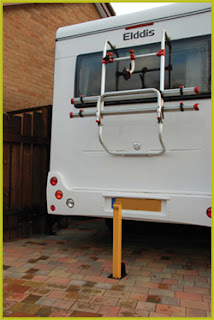
caravan security post
Caravan Security Post
So, what is the benefit of installing locking security measures? Beyond the obvious, the reduced risk or chance of theft, using these additional security tools can reduce the price of insurance. Some insurance companies will provide a discount for leisure vehicles that are kept in a safer location, thanks to that same reduced risk.

Immobilisers and alarms
As with any other on-road vehicle, from trucks to cars, the use of inbuilt alarms in caravans and motorhomes is a necessary feature that comes as standard with many of the more modern models available on the market. But it’s possible to do even more to prevent break-ins and theft by announcing the presence of an alarm system, via a visible device or using well-placed stickers. These can be as much of a deterrent as the alarm itself. These are the options typically available to leisure vehicle owners:

Alarms
Many tourers come with alarms as standard. As with a house alarm, these are designed to trigger if an intruder accesses the vehicle. In some cases, these alarms can be linked directly into a security company for added safety. In others and more standard models, these alarms make a great deal of noise to draw attention to potential theft.

Immobiliser
Again, like any other form of on-road vehicle, caravans and campervans often include an immobiliser device. This security tool prevents thefts should the worst happen by not allowing the vehicle to be driven unless it is unlocked first. Some modern vehicles include this as standard, while older models may require a physical immobiliser that is directly fixed to the wheels. It’s worth confirming if your caravan or motorhome includes the less physically demanding method when you purchase it, as it is a valuable feature to have.

As with the security locks and clamps mentioned above, the inclusion of a high-quality alarm and immobiliser – either included with your vehicle or added as extras – can bring down the overall cost of insurance. As these features are significant deterrents to theft, they make your vehicle less high-risk, and therefore your insurance quotes cheaper.

Other security options
In addition to alarms, immobilisers and locks, modern caravans and campervans can come with, or be equipped with, a whole host of different security devices to further reduce the cost of your insurance. Here are just a few of the additional security options that could be installed for safety, security and insurance reduction:

Tracking devices
Tracking devices are an increasingly common option for both caravans and campervans, with some insurers now offering a discount on insurance when recommended tracking devices are installed within the vehicle. These devices are not visible, discrete and easy to use, often allowing tracking either through a security company or smartphone. Should your vehicle be stolen, it vastly improves the chances of recovery – which is why it can be a great way to get a discount on your campervan insurance.

Dashcams
A less common but increasingly popular addition to motorhomes and campervans, dashcams are a vital evidence tool for insurance companies. As such, it makes sense that installing both front-facing and rear dashcams within a campervan can sometimes reduce your insurance costs, especially when it comes to being on the road for days or weeks at a time.

Choosing the best insurance for you
Picking the best campervan or caravan insurance for you means ensuring that it does everything you want it to do. But equally, you want to pick an insurance that puts your safety, and that of your vehicle, first. 


Friday, 8 June 2018

Caravan Insurance Secrets!


How do underwriters rate your touring caravan?

If you are buying a touring caravan this year or when the renewal of your caravan insurance comes around, you might be asking yourself how underwriters rate your particular make and model to arrive at the premium you are charged.

Some of the considerations insurers are likely to take into account include the following:
caravan insurance 
The make and model of your touring caravan

Underwriters have access to copious data on the relative costs of repairing or replacing touring caravans of different makes and models since this is clearly a relevant cost to them in the event of you making a claim. The more expensive your caravan type, typically the more your caravan insurance will cost you.

The age and value of the caravan

Very similar reasons to the above make the age and value of your touring caravan relevant to underwriters, who need to calculate the likely cost in replacing it or writing it off in the event of a total loss.

Your postcode

Insurers calculate the likelihood of theft or vandalism of your touring caravan with reference to the postcode of your address, as some areas are more vulnerable than others. Although it relates to motor insurance, the AA has published a list of postcodes ranked by insurers from the cheapest to the most expensive areas.

caravan storage Central Registration and Identification Scheme (CRiS)

Underwriters need to know whether your particular make and model is registered with the Central Registration and Identification Scheme (CRiS).

It is a requirement for all recently manufactured UK makes and provides a kind of “log book” for caravans, identifying current and previous owners, whether it has been stolen or previously written off, and if there is outstanding finance on it.

Use

Underwriters also take into account whether you intend to use your touring caravan in the UK only or also plan to take it abroad. This may have a bearing on how often you plan to use it – insuring your caravan for the occasional outing each year might cost less than your avid use of it on frequent touring holidays.


Some underwriters also give you credit for improving the security of your caravan when it is at its most vulnerable, out of season or when it is otherwise laid up and not in use.

For example, caravan insurance specialists Cover4Caravans, have worked with underwriters to offer up to a 15% discount on the cost of touring caravan insurance for ‘vans stored at a site registered by the Caravan Storage Site Owners’ Association (CaSSOA).

The next time you ponder how underwriters might have assessed the amount of insurance premium you need to pay, these are just some of the considerations likely to have been taken into account.

To locate a CaSSOA caravan storage site, click here.


Friday, 1 September 2017

Caravan Park Security

At CaSSOA we’re all about providing secure storage for your caravan or motorhome when it’s not in use. But what about when you’re out and about on holiday?Security is still important when you’re away so here are some points to consider when leaving your tourer on a caravan park. 

  • Lock all windows, doors and skylights. 
  • Hide all valuables from view – including TVs and other electrical equipment. Remember to mark these with a UV or permanent marker so that they can be traced back to you if stolen. 
  • Consider using a floor-anchored safe. 
  • Take keys, money, credit cards and passports with you when leaving your caravan. 
  • Leave curtains open (after hiding valuables from view) so that it can be seen that there is nothing of value to steal. 
  • Consider purchasing an alarm system to alert others if your caravan is broken into.  
  • Security posts and wheel clamps can also be used when you’re away from your caravan. Visible security devices like these act as a visual deterrent.  
  • Make friends with neighbouring caravanners – they’re more likely to raise the alarm if someone unfamiliar is loitering around your caravan.  
  • Awnings can be useful – not only to add extra living space. A thief may be less likely to steal a caravan with an awning because of the time they’d need to take it down or cut it away. 
And finally, check your caravan insurance policy to see if there are any specific requirements you need to be aware of whilst taking your caravan away from its storage location.

Monday, 30 November 2015

The Caravan Industry & Security – Protecting Your Caravan

The caravan industry is an ever changing market, and with that comes developments in security as well as trends in caravan crime. Tim Booth, from the Caravan Safety and Security Group gives us a run down on what’s happening at the moment.


Looking at recent press reports it is very apparent that the Leisure Market is currently very buoyant, with both caravan and motorhome manufacturers reporting  high levels of sales. There is also a marked increase in the number of sales of European manufactured caravans.

Whenever a buoyant market for sales exists in any industry this is often seen by criminal groups as an opportunity to take advantage of a ‘high demand’ by seeking to meet this demand themselves. Of course, they achieve this supply at the expense of the current keeper or even the dealership, by stealing the caravans that they supply.

This then, is an important time of the year to make sure that you do everything you can to protect your caravan or motorhome.

Make sure that your caravan insurance cover is up to date and that you are meeting the requirements of the policy.

Of course it is not always possible to store your caravan or motorhome at your home address, due to planning conditions, and for some a lack of space – so owners increasingly turn to storage site providers.

It is a fact that many of the caravans being stolen are actually being taken from ‘informal’ storage sites – where caravans and motorhomes are just ‘parked up’ for the winter period. There are no inspections made by the site owner, or even the consumer. Many of the tracking systems fitted at time of manufacture only actually activate once the owner discovers that their property has been stolen, and then notifies the tracking company – the property can be long gone by then and chances of recovery are generally very low.

A ‘pro-active’ system will notify you if there are any issues that need to be addressed, so it is worth checking whether this is the type of system that you have – if your caravan or motorhome is fitted with such a system are you subscribed to their monitoring service?

Certificated storage sites, like the CASSOA scheme, offer the consumer a level of protection that is recognised by many insurers as a ‘positive deterrent’ to opportunist thieves. Some even offer insurance benefits for using such a facility.

Of course – if you are considering buying a caravan or motorhome, then make sure that you carry out a CRiS check on any caravan – this can tell you whether the caravan is currently stolen, or if there is finance outstanding. A HPI check can provide you with similar information about a motorhome. 

The cost of these checks could prevent you from becoming a victim of those people who choose to steal caravans and motorhomes, and then look to target unsuspecting consumers.

These straight forward measures can serve to protect your caravan or motorhome from being targeted by thieves.

Tim Booth provides specialist security advice to the caravan and leisure industry. He also works to support the National Caravan Council, The Camping and Caravanning Club and The Caravan Club by delivering an industry group called the Caravan Safety and Security Group.