
Whether you’re sticking close to home or travelling on the
road trip of a lifetime, fitting the proper security devices to your campervan
is the best way to ensure your safety. But not only do security devices play a
crucial role in maintaining your safety, but they can also have a direct impact
on your caravan or campervan insurance. Many insurers advise that security
options should be added to your touring vehicle, but what do these additions do
in terms of your insurance? In some cases, it can have a positive impact on the
price you pay.
Read on to discover more about security devices and the ways
they can impact the price you pay for your leisure vehicle insurance when it
comes time for renewal.
Locking devices and
clamps
The most basic and classic of security devices, security
locks are a common measure that many caravan and campervan owners use to avoid
their vehicle being broken into or stolen when left alone. Either when
travelling or on the front drive, these locking systems are just as effective either
way to ensure your contents are left secure, and your tourer is kept safe.
There are many different forms of locks and clamps available on the market,
including:
 |
| Caravan Wheel Lock |
Steering wheel locks
This classic method applies to campervans and motorhomes in
the same way it applies to other on-road vehicles such as cars and vans.
Typically, a steering wheel lock is placed over the wheel of the vehicle, preventing
the theft of the vehicle without the ability to unlock. Some campervans now
come with this feature built-in, though it depends on the exact model.
Ground anchors
A form of lock traditionally used for both caravans and campervans,
these anchors all for the secure fixing of the vehicle to the floor. This
method is particularly useful for times when your tourer is left at home,
whether you’re at work or going on a trip abroad without it. It ensures the
vehicle cannot be driven away using specialised clamps that are incredibly
strong and hard-wearing.
Security posts
A measure often used in commercial and retail car parks,
security posts can be an excellent way to prevent a caravan or campervan from
being stolen; by literally blocking the exit route. In the majority of cases, a
removable post can be locked upright in front of a vehicle to prevent the caravan
or campervan from getting past if stolen. These posts may be more costly as
their required cementing to be useful, but they can be a highly valuable tool
to prevent theft.
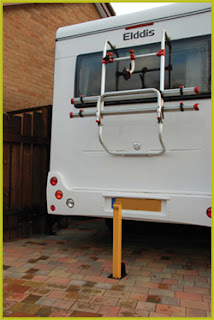 |
| Caravan Security Post |
So, what is the benefit of installing locking security
measures? Beyond the obvious, the reduced risk or chance of theft, using these
additional security tools can reduce the price of insurance. Some insurance
companies will provide a discount for leisure vehicles that are kept in a safer
location, thanks to that same reduced risk.
Immobilisers and
alarms
As with any other on-road vehicle, from trucks to cars, the
use of inbuilt alarms in caravans and motorhomes is a necessary feature that
comes as standard with many of the more modern models available on the market.
But it’s possible to do even more to prevent break-ins and theft by announcing
the presence of an alarm system, via a visible device or using well-placed
stickers. These can be as much of a deterrent as the alarm itself. These are
the options typically available to leisure vehicle owners:
Alarms
Many tourers come with alarms as standard. As with a house
alarm, these are designed to trigger if an intruder accesses the vehicle. In
some cases, these alarms can be linked directly into a security company for
added safety. In others and more standard models, these alarms make a great
deal of noise to draw attention to potential theft.
Immobiliser
Again, like any other form of on-road vehicle, caravans and campervans
often include an immobiliser device. This security tool prevents thefts should
the worst happen by not allowing the vehicle to be driven unless it is unlocked
first. Some modern vehicles include this as standard, while older models may require
a physical immobiliser that is directly fixed to the wheels. It’s worth
confirming if your caravan or motorhome includes the less physically demanding
method when you purchase it, as it is a valuable feature to have.
As with the security locks and clamps mentioned above, the
inclusion of a high-quality alarm and immobiliser – either included with your vehicle
or added as extras – can bring down the overall cost of insurance. As these
features are significant deterrents to theft, they make your vehicle less
high-risk, and therefore your insurance quotes cheaper.
Other security
options
In addition to alarms, immobilisers and locks, modern caravans
and campervans can come with, or be equipped with, a whole host of different
security devices to further reduce the cost of your insurance. Here are just a
few of the additional security options that could be installed for safety,
security and insurance reduction:
Tracking devices
Tracking devices are an increasingly common option for both
caravans and campervans, with some insurers now offering a discount on
insurance when recommended tracking devices are installed within the vehicle.
These devices are not visible, discrete and easy to use, often allowing
tracking either through a security company or smartphone. Should your vehicle
be stolen, it vastly improves the chances of recovery – which is why it can be
a great way to get a discount on your campervan insurance.
Dashcams
A less common but increasingly popular addition to motorhomes
and campervans, dashcams are a vital evidence tool for insurance companies. As
such, it makes sense that installing both front-facing and rear dashcams within
a campervan can sometimes reduce your insurance costs, especially when it comes
to being on the road for days or weeks at a time.
Choosing the best
insurance for you
Picking the best campervan or caravan insurance
for you means ensuring that it does everything you want it to do. But equally,
you want to pick an insurance that puts your safety, and that of your vehicle,
first.
